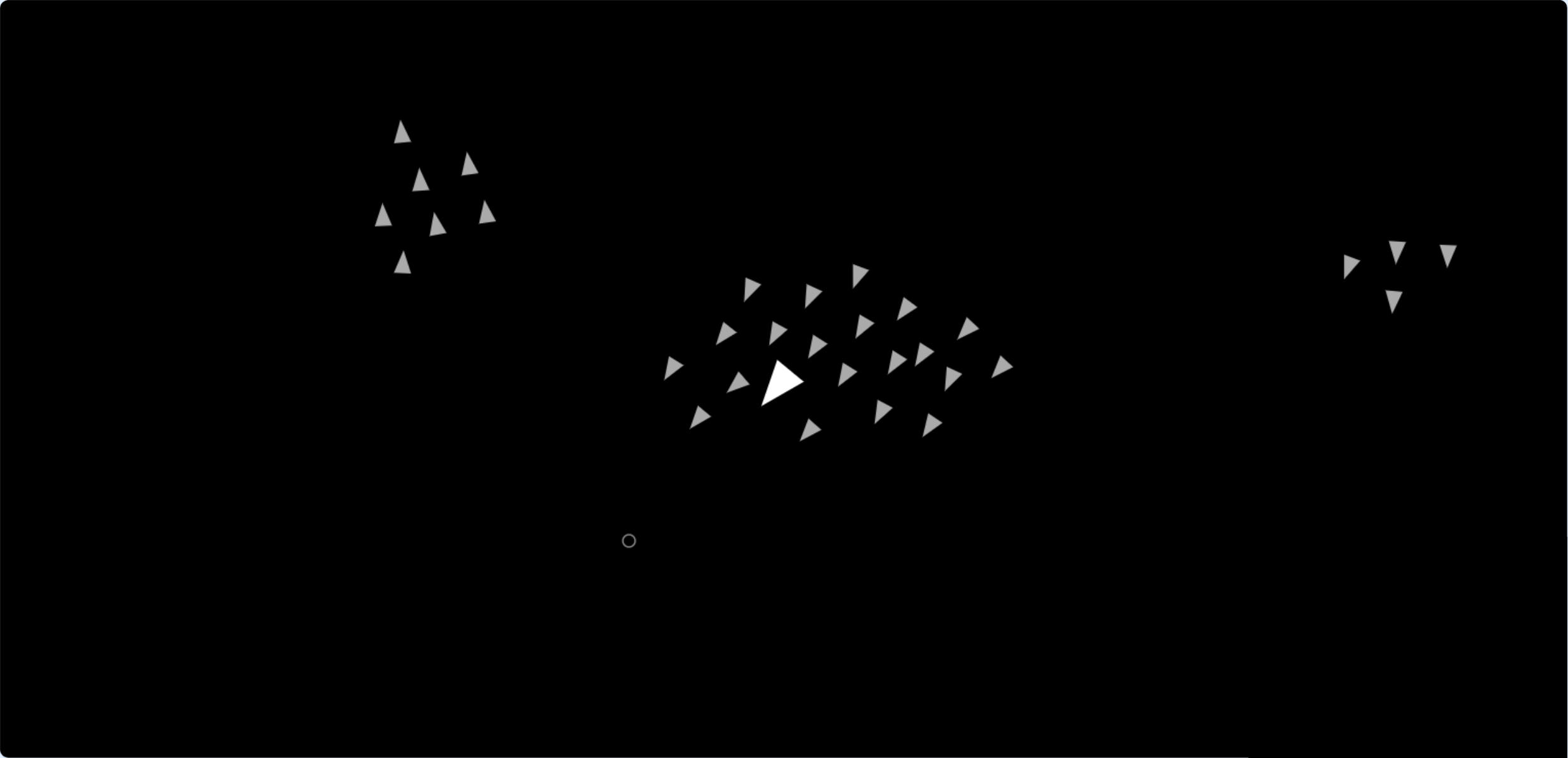
Track 2 ALPHA
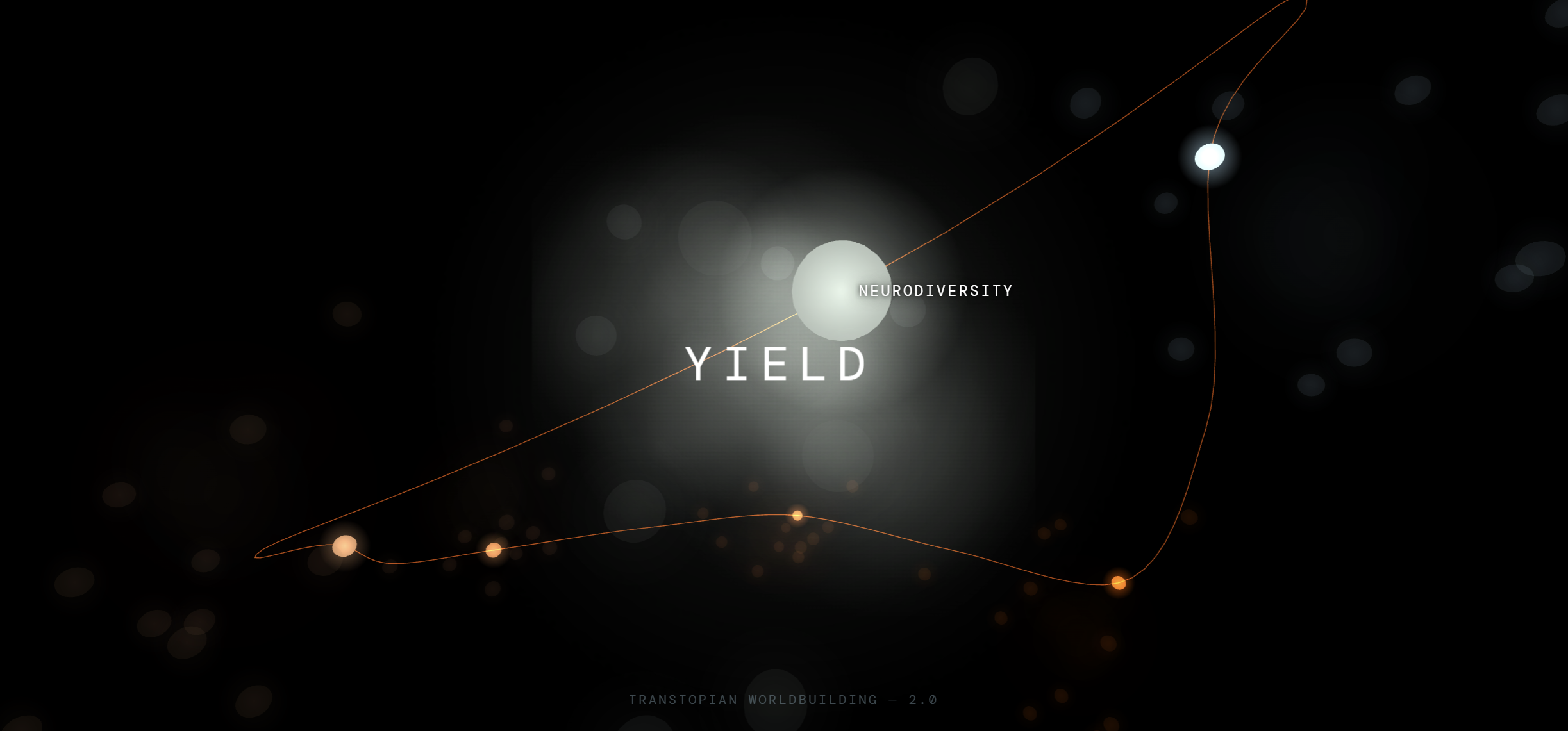
Experimental branch (3D refinement)
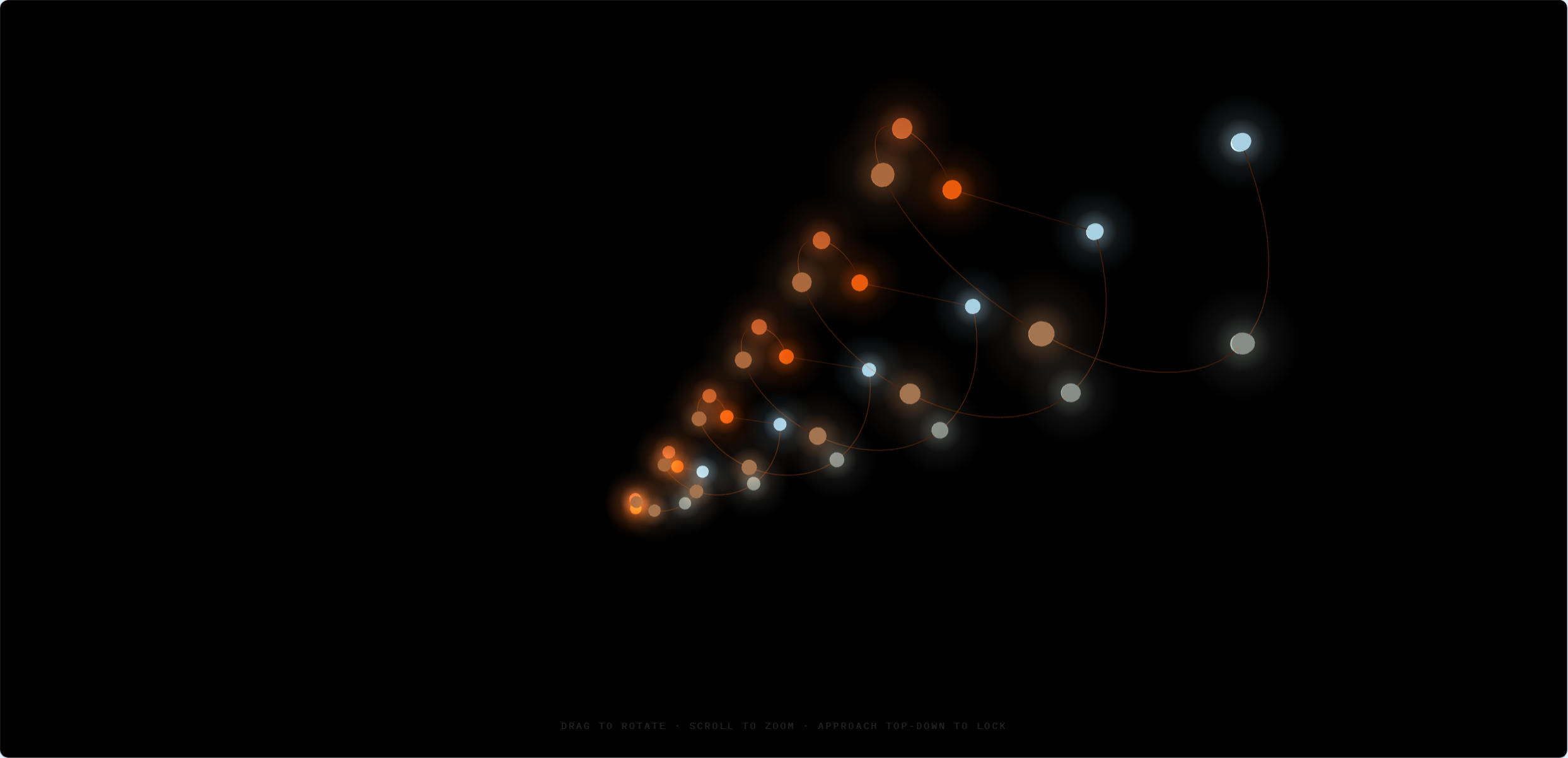
Track 1 TOPOLOGY
History
-
1.3 file split
Architectural refactor: 1.2 split across 5 files so the boundary between emergence (universe laws) and prescription (design choices) is legible at the file level. sunField unified, d3-force removed, content pipeline scaffolded.
-
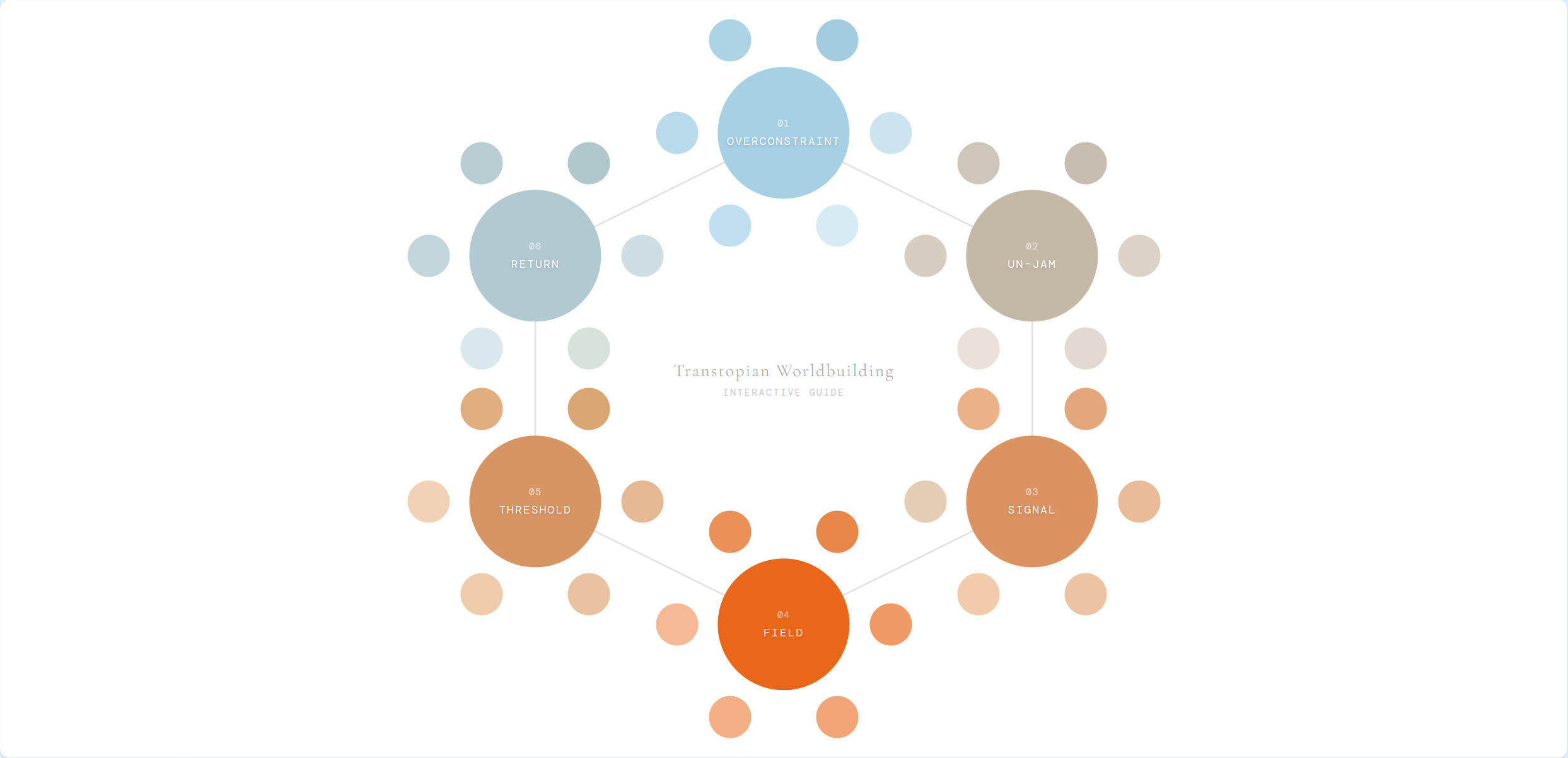
1.2 physics-driven Form A
N=12, Form A becomes a live N-body system (gravity + core repulsion + pair repulsion). Identity-grouped hover across both forms.
-
1.1 abstract identity
Architectural rewrite: N × S¹ topology, spherical default, single project() function, Form B animation with per-planet hover slowdown.
-
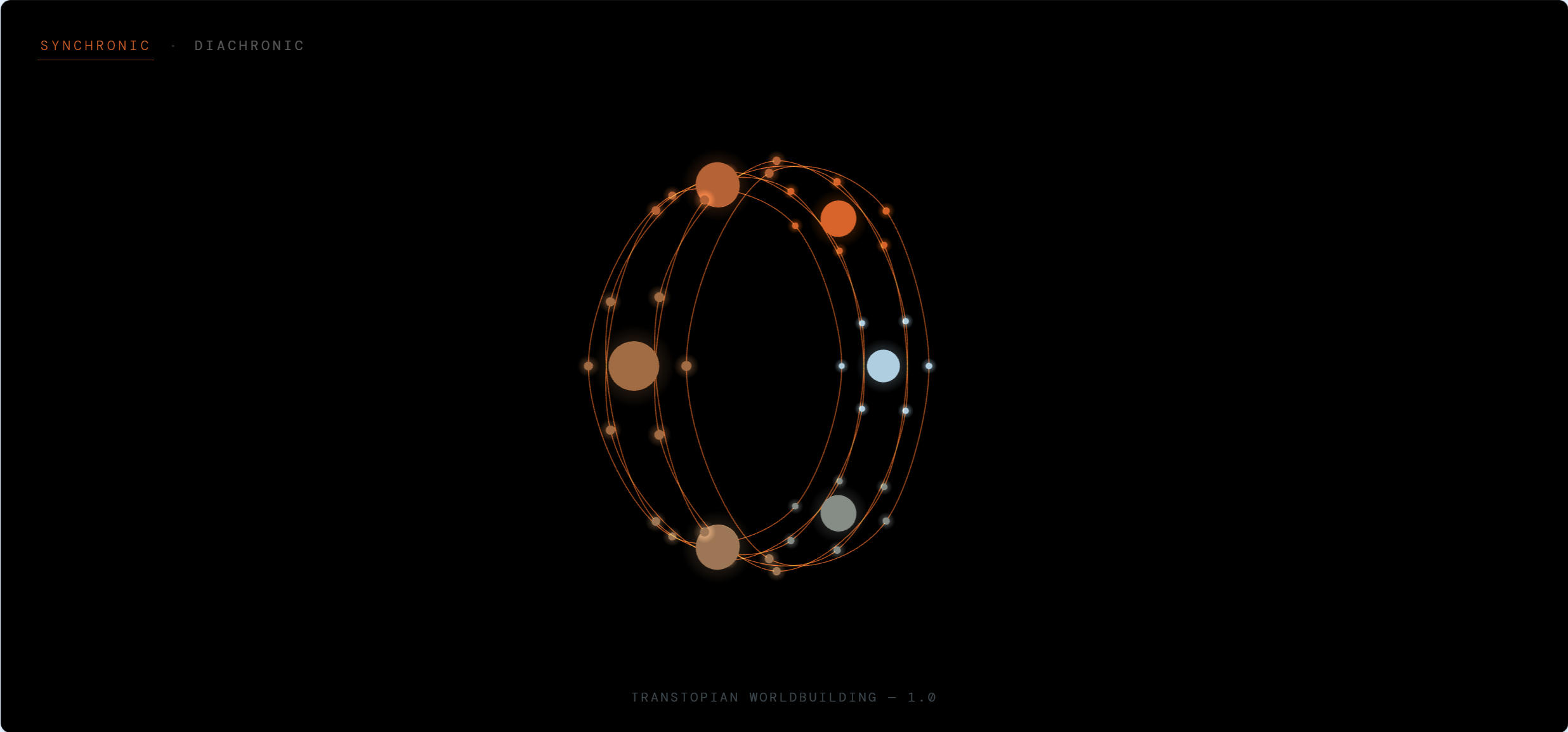
1.0 morph
The simplest viable starting point: two static forms with an animated transition bridging two visual models.
Track 0.1 STATIC WEB
History
-
0.1.7 pointy-top restore
Restores 0.1.5's pointy-top hexagon orientation (Lina's preference) and hardens all three layers against extreme zoom + narrow-window edge cases. Ctrl+wheel now falls through to the browser zoom instead of being swallowed as navigation.
-
0.1.6 dissertation attempt
First dissertation-delivery attempt: brand frame always visible; new mathematically-derived phase palette (blue→green→yellow→orange, U-shaped saturation); "PHASE N" prefix everywhere; L2 half-sun + PHASE-N label as phase-switch entry; L3 body-text fade via top/bottom masks (has a known sun-clipping tradeoff, fixed in 0.1.8).
-
0.1.5 brand frame integrated
First integration of Todd's brand frame (`resource/brand-frame.js`). Adds the L2 capsule overlay — clicking the center sun shows its description inside the capsule, tinted with the sun's radial gradient. Frame colour follows the current phase on L2/L3. Digits, arrows, planet-name typography unified across all layers.
-
0.1.4 s-curves + gradient suns
Adds S-curve connectors between each planet and its sun (edge-to-edge, alternating by parity), radial-gradient suns (saturated rim → translucent core), and hollow outline planets. Establishes the visual grammar carried through the rest of 0.1.x.
-
0.1.3 brand atmosphere
Adds Lina's brand atmosphere — a dark purple→black radial background with a faint starfield across L1/L2, and a top-down purple→black gradient in the reading view (L3). Hovering a sun cross-fades its number into its name, in place.
-
0.1.2 2d
Reboots the 3-level structure on a black background with real shared text, the lines between suns removed, and mobile support.
-
0.1.1 pptext
The 3-level structure with particle-physics text filled into the phases.
-
0.1.0 logic
The foundational blueprint testing how information and layers are structured.
Track 0.2 2D DYNAMIC
Experimental branch (transitions)
History
-
0.2.9 a way in
The problem was small and serious: nobody realised the words could be touched. So the centre of the opening screen grows a way in — the guide's own name set inside a thin capsule, a short stroke curving away on either side, brighter than the title above it and brighter still when the cursor arrives, lit faintly from within its own rim. That same light spreads outward: point at an example and it glows at its edge, and once you are down among the phases, the one held in the middle carries a stronger version of it, swelling and fading as you turn the wheel past it. On a wide screen the title settles onto a single line and the two side suns step outward to make room; narrow the window and it folds back into two. On a phone the model, the title and the way in stand together as one block in the middle of the screen.
-
0.2.7 drawn suns
Six drawn suns take their place inside the circles where a printed label used to be, and the wheel of examples grows to ten. Nothing is cropped: the outermost planets are whole circles, they carry their names, and one tap reaches them. Narrow the window and the whole scene gives way continuously instead of snapping between two layouts. Two fingers do the travelling — spread them over a sun or a planet to go deeper, draw them together to come back out — and on a phone a flick carries you to the next phase, the chosen planet tracing a small S in the air as it goes. The reading column quietly loses its dividing line and its scroll-back button.
-
0.2.6 signed off
The version that closed the 2D line in July 2026. Phones get first-class treatment: the whole scene scales as one piece so nothing turns lanky on a small screen, a tap on a sun reveals its name before carrying you inward, and a two-finger pinch takes you back out. Dragging becomes free here — the ring follows your finger as far as you pull it, settles on whichever station ends up nearest, and can be caught again mid-settle, so you are never left waiting on an animation to finish.
-
0.2.5 shared layer
The brand frame goes hidden by default and reappears as a small ceremony when a text panel opens. Text, audio and the frame itself move out into a shared layer that every version reads from, so one edit reaches all of them. A traveling wave runs along the S-connectors and floats the planets at their ends. Drag navigation arrives here, but still clamped to one step at a time.
-
0.2.4 animation engine
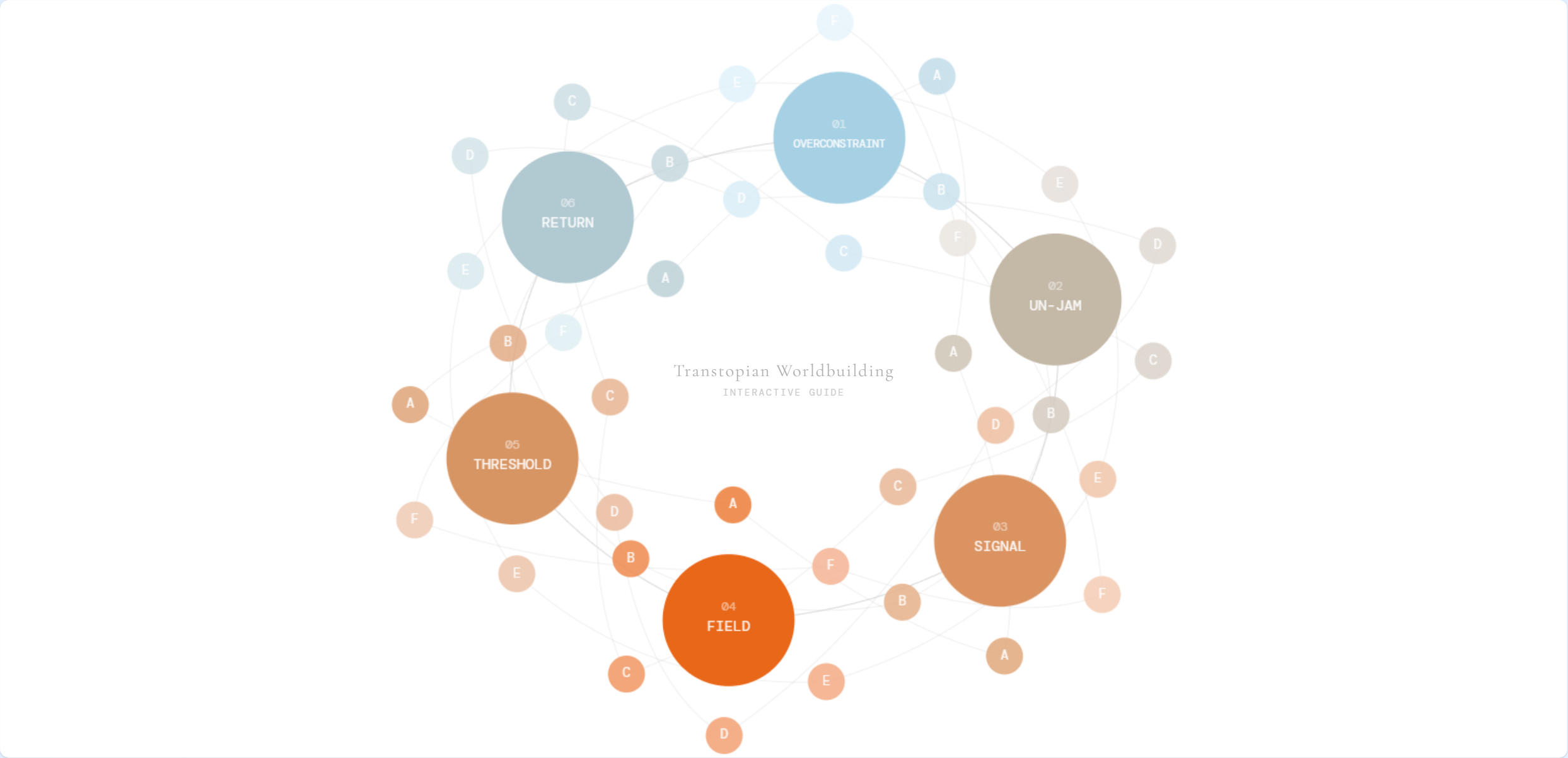
First dynamic version (renamed from 0.1.9). rAF animation engine with P key planet orbit + S-line sway, S key sun revolution. Three-layer phase-switch animations (fade–slide–fade on L2, ring rotation + phase-slide on L3). About-the-Guide capsule overlay on L1 centre title.
-
0.2.3 lines
Rotation dynamics on the macro view with connecting lines between planets across stars — the alternating directions create emergent visual patterns.
-
0.2.2 cog
Explores mechanical friction, treating planets as interlocked gears.
-
0.2.1 rotate
Sets the cosmos in motion with simple clockwise orbits.
Track 0.3 3D
History
-
0.3.4 lines
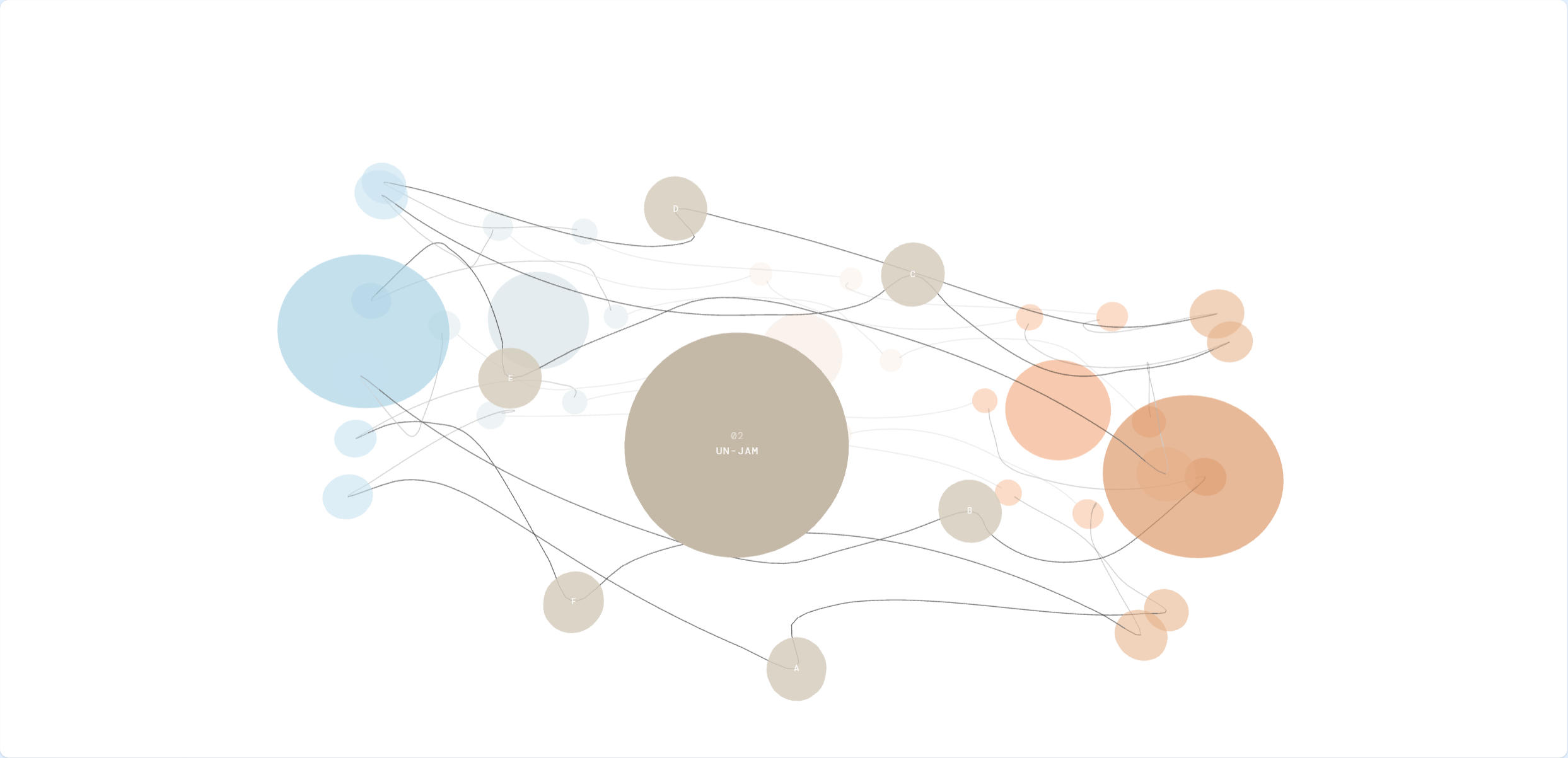
The grand synthesis: 3D free movement meets physics-driven connecting threads.
-
0.3.3 freeview
Unlocks the camera, granting complete freedom to drift through the 3D space.
-
0.3.2 horizontal
A horizontal arrangement where dragging pulls you into alignment with the nearest star.
-
0.3.1 rotate
A vertical ring structure you navigate by scrolling down.
Track 0.4 POLAR
History
-
0.4.4 manipulate
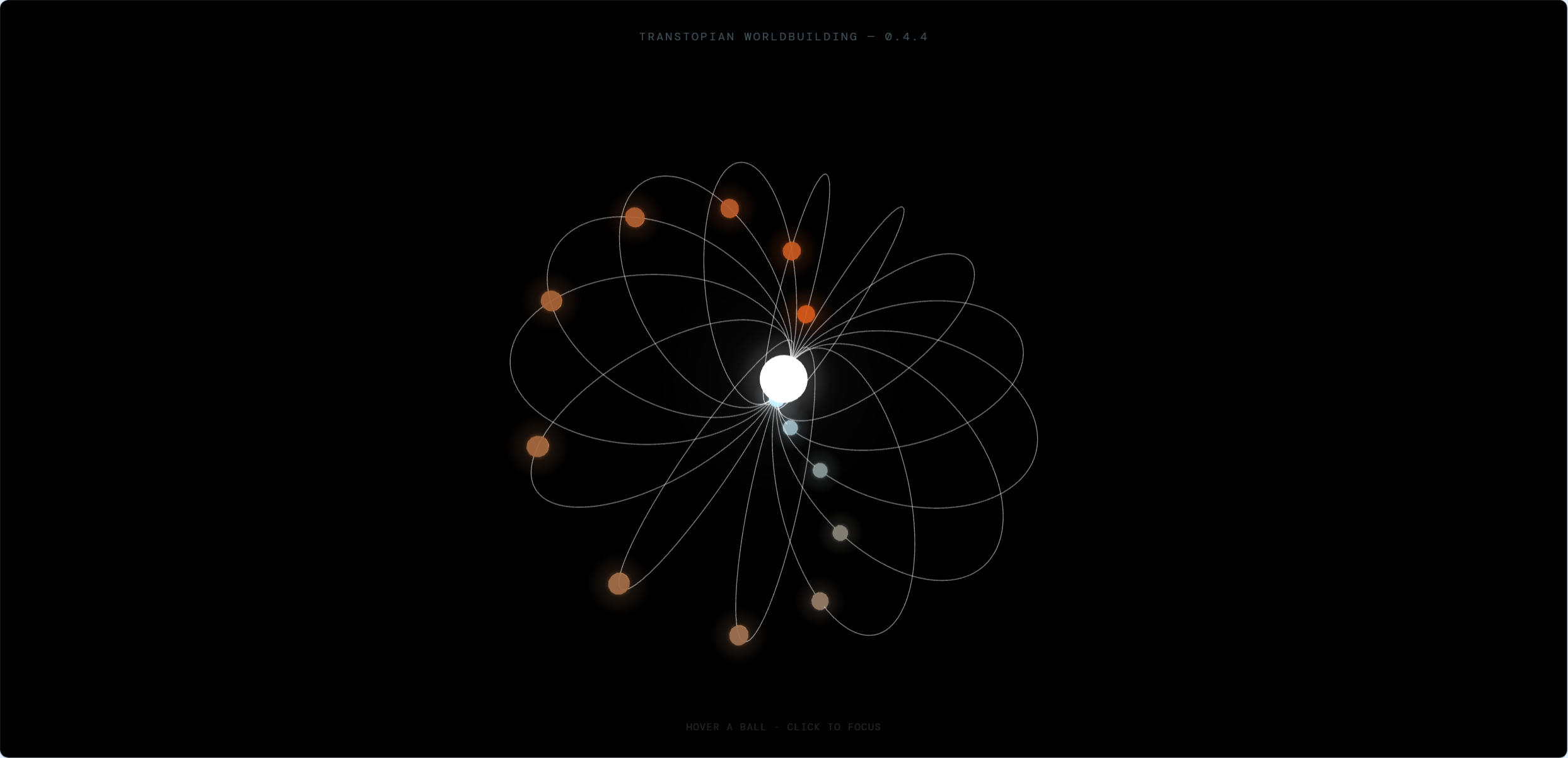
Planet as scroll progress bar through the phases, with the emergent time-jump exit mechanic. (Self-contained, hardcoded text.)
-
0.4.3 planetfocus
Allows you to break away from the whole and zoom into a single planet's orbit.
-
0.4.2 animated
The magnetic loops come alive, pulsing along their predetermined tracks.
-
0.4.1 fieldloops
Planets envisioned as static magnetic dipole loops wrapping a central core.
-
0.4.0 ball
A beautiful geometric accident that felt too striking to delete.